
Lintec & Linnhoff debuts containerised CSE1500 asphalt plant at bauma China 2026
The modular 120 t/h plant is built into ISO-certified shipping containers and assembles in as little as three days without a main-tower foundation.
www.lintec-linnhoff.com
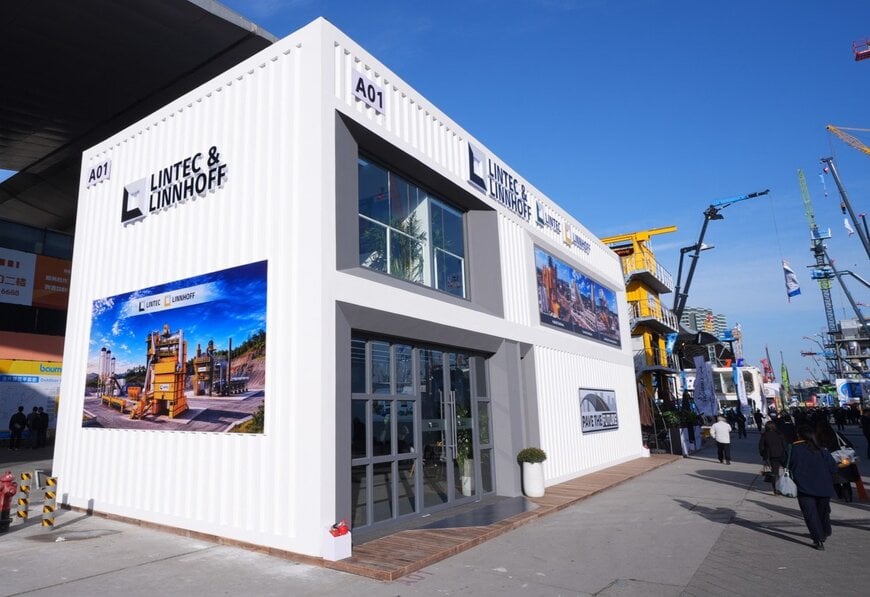
Lintec & Linnhoff unveiled the Lintec CSE1500 containerised asphalt mixing plant in Shanghai during bauma China 2026 (where the company exhibits at two-level booth A01). Positioned as a more economical version of Lintec's conventional CSM containerised asphalt plant, the CSE1500 is engineered for contractors seeking German-engineered control systems and reliable mix quality at a more accessible capital investment without compromising production output.
Delivering a production capacity of 120 tonnes per hour at 3% moisture content, the CSE1500 integrates its core components within standard ISO-certified sea containers, simplifying transport, installation, relocation, and dismantling compared to conventional stationary plants.
Key benefits of the containerised design
- 100% ISO-certified sea containers: All primary components of the CSE1500 are housed within standard ISO-certified shipping containers, streamlining logistics planning, customs clearance, storage, and relocation over the plant's service life. Excluding the optional hot-mix storage silo, a complete plant has an approximate shipping weight of 120 tonnes and is transported in a combination of 20-foot and 40-foot containers to keep freight costs predictable.
- Foundation-free installation: The main tower requires no concrete foundation, and the plant can be installed directly on compacted ground, saving civil engineering time and costs while avoiding concrete pouring and curing delays. The plant can also be dismantled and relocated without leaving permanent structures behind, suiting temporary jobsites and short-term contracts.
- Rapid assembly and dismantling: Modular, pre-integrated units enable the plant to be erected in as little as three days, reducing on-site labour and enabling contractors to start production quickly and relocate between changing sites with minimal downtime.
- High production efficiency: A German MIPROTEK control system ensures precise, automated asphalt production, maintaining consistent batch-to-batch quality, reducing reliance on manual adjustments, and supporting efficient daily operation.
- Precise aggregate screening: A six-deck vibrating screen separates aggregates into well-defined fractions prior to mixing, enabling tight control over final mix design to meet project specifications and reduce the risk of rejected loads.
- Internationally sourced key components: Critical plant functions incorporate components selected from internationally recognised suppliers and backed by Lintec's engineering expertise to support reliable operation, steady output, and extended service life.
Executive perspectives on accessibility and rapid deployment
Tony Liu, Head of Asphalt at Lintec & Linnhoff, stated: "The Lintec CSE1500 offers our customers a simpler and more economical way to own a conventional containerised asphalt plant. By designing the plant around standard sea containers, we have reduced the effort required to transport, install, and relocate it. With an erection time of as little as three days and no need for a concrete foundation for the main tower, customers can begin producing quality asphalt in less time and move on to the next project with confidence."
Peter Isaac Chan, Group CEO of Lintec & Linnhoff, added: "Lintec & Linnhoff is committed to helping its customers build better roads through reliable technologies and at a cost that makes sense for their businesses. The Lintec CSE1500 reflects that commitment. It puts our engineering expertise and control systems within reach of a greater number of contractors, and bauma China is the ideal place to introduce it to the market."
With the Lintec CSE1500, Lintec & Linnhoff brings German-engineered asphalt production within reach of more contractors. Faster to install, easier to relocate and more economical to acquire and operate, the plant is designed to help customers start work sooner and build better roads.
Additional Context:
This section explains general principles of batch asphalt mixing towers and containerised modular plant architecture in road construction not included in the original press release.
In batch-type asphalt mixing plants, virgin aggregates are first dried and heated in a rotary drum before being elevated to the top of a vertical mixing tower. There, a multi-deck vibrating screen separates the hot aggregates by particle size into distinct hot bins. An automated weighing system then doses exact proportions of each aggregate fraction, mineral filler, and heated bitumen into a twin-shaft pugmill mixer for each individual batch—allowing operators to switch rapidly between different asphalt mix recipes to satisfy strict highway paving specifications.
Traditional stationary batch towers typically rely on heavy structural steelwork anchored to reinforced concrete footings to resist wind loads and vibrating screen forces, which can require extensive civil site preparation. In containerised modular designs, the frames of ISO shipping containers, with their corner castings and twist-lock connections, can form part of the load-bearing structure, distributing static and dynamic operating loads onto compacted ground or load-spreader plates.
Edited by an industrial journalist, Lekshman Ramdas, with AI assistance.
