
constructionequipmentmag.com
11
'26
Written on Modified on
SU-4 deploys Lintec CSM3000 asphalt plant in Kyrgyzstan
The modular 240 t/h facility in Kara-Balta enables rapid deployment for growing regional infrastructure projects.
www.lintec-linnhoff.com
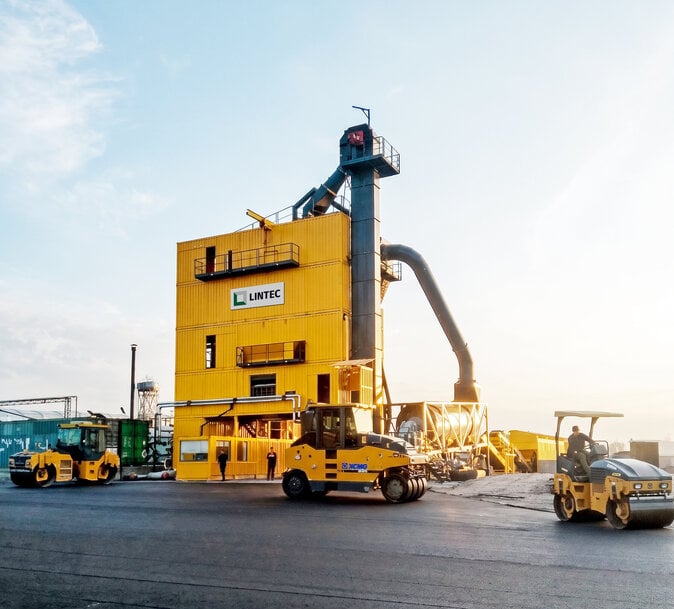
Lintec & Linnhoff has successfully commissioned a Lintec CSM3000 Asphalt Mixing Plant for construction contractor SU-4 in Kara-Balta, Kyrgyzstan. Designed to produce up to 240 tonnes of high-quality asphalt mixes per hour, the new facility is currently supporting a surge in national infrastructure development. The deployment underscores a growing demand across Central Asia for high-performance, highly mobile batching solutions capable of reliable operation under diverse site conditions.
Rapid deployment and modular engineering
SU-4’s decision to procure the CSM3000 was driven by firsthand observations of Lintec's modular engineering. In the spring of 2025, SU-4 representatives visited a separate project site in Bishkek, Kyrgyzstan, where they witnessed the installation of a larger Lintec CSM4000 plant. The contractor noted that the main mixing tower was fully erected in a single week, with commissioning tests commencing just two weeks later. Following a technical evaluation at Lintec & Linnhoff’s manufacturing facility in Jiangsu, China, SU-4 selected the CSM3000 configuration for its own operations, prioritizing the ability to relocate the plant quickly as infrastructure demands shift.
The CSM3000 achieves this mobility through its containerized structure, which vastly simplifies road logistics and minimizes site preparation. To further shorten the timeline between delivery and asphalt production, the plant features pre-wired plug-in electrical connections and a decentralized control system, effectively eliminating the complex on-site wiring historically required for heavy batching plants. According to Sergey Kolpakov, CEO of SU-4, the seamless installation and advanced process control software have fortified the company's operational efficiency and readiness for future highway projects.
Additional Context: ISO containerization and decentralized industrial control
This section details the mechanical and electrical principles of modular asphalt batching that are not included in the original press release.
In heavy highway construction, the logistical footprint and deployment speed of an asphalt batching plant are critical economic drivers. Traditional stationary asphalt plants require massive, poured concrete foundations and complex, hardwired electrical routing across the site, making plant relocation prohibitively expensive and time-consuming. The Lintec CSM3000 circumvents this by utilizing a fully containerized structural architecture that is built entirely into ISO shipping containers. Every primary process component—from the vibrating screens and twin-shaft mixer to the hot elevator and weighing mechanisms—is structurally integrated into these modules. This design allows the plant to be rapidly stacked and interlocked vertically. Because the containers provide a wide, rigid base, the plant can often be erected on compacted soil or steel plates without heavy civil foundation work, drastically cutting setup time and transport logistics.
Furthermore, the integration of "plug-in" electrical networks and decentralized control systems fundamentally accelerates the commissioning phase. In older, centralized architectures, hundreds of individual analog and digital control wires had to be manually pulled from every limit switch, load cell, and motor starter back to a central programmable logic controller (PLC) in the operator cabin. A decentralized approach utilizes remote distributed I/O modules located locally within each container, connected via a high-speed industrial network (such as PROFINET, EtherCAT, or CAN bus). This allows each modular container to be meticulously pre-wired and tested at the factory. Upon stacking the tower on site, technicians simply connect heavy-duty multi-pin plugs and a central communication cable. This plug-and-play topology eliminates manual wiring errors, instantly networks the entire plant's telemetry, and enables high-precision automated process control from day one.
Edited by an industrial journalist, Lekshman Ramdas, with AI assistance.
www.lintec-linnhoff.com
