
constructionequipmentmag.com
19
'26
Written on Modified on
LFP Battery Module for Compact Electric Machinery
Forsee Power's ZEN 8 LFP battery delivers over 245 Wh/L without liquid cooling and directly replaces NMC packs in sweepers and compact machinery.
www.forseepower.com
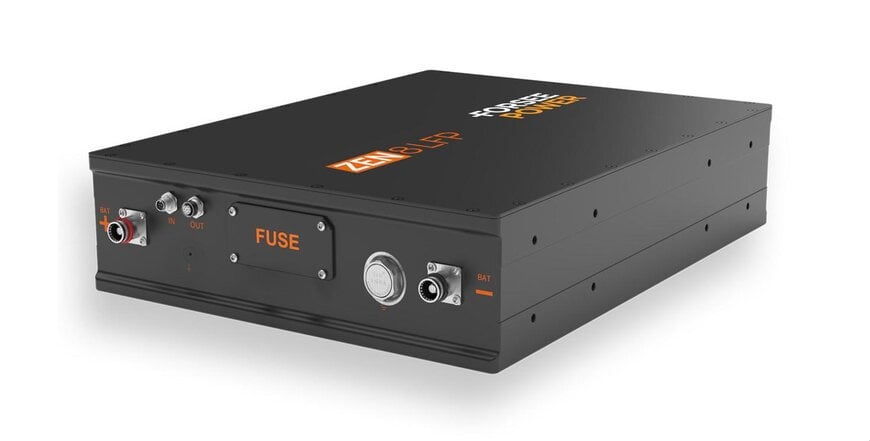
Electrifying compact off-road machines and municipal vehicles requires batteries that fit tight installation spaces, run a full working shift and comply with tightening European regulations. Forsee Power has introduced the ZEN 8 LFP, a lithium iron phosphate (LFP) battery made in France for urban cleaning equipment, commercial utility vehicles, construction machinery and agricultural vehicles.
Energy Density and Cell Technology
The ZEN 8 LFP reaches an energy density above 245 Wh/L using next-generation 173 Ah LFP cells and a nominal module voltage of 45 V. It matches the energy capacity and voltage range of the existing NMC version of the ZEN 8 while improving performance and cycle-life targets. LFP chemistry is generally valued in industrial applications for its thermal stability and long cycle life.
Thermal Architecture Without Liquid Cooling
The battery's thermal architecture removes the need for liquid cooling, which simplifies vehicle integration by eliminating coolant circuits and associated components and reduces overall system complexity. The targeted fast-charging rate is 0.7C.
Drop-In Replacement for NMC Systems
The ZEN 8 LFP retains the external dimensions and mounting points of the NMC ZEN 8. Existing OEM customers can therefore switch chemistry without redesigning their vehicles, shortening development and validation cycles.
Applications in Sweepers and Off-Road Machinery
For compact electric street sweepers, pack configurations range from 50 kWh to 130 kWh, targeting eight hours of operation. The battery is also designed for compact non-road machinery, including low-tonnage excavators, loaders, telehandlers and tractors.
European Manufacturing and Regulatory Compliance
Production in France supports OEMs facing European industrial and local-content requirements, including those under discussion in the Industrial Accelerator Act (IAA). The battery is designed to meet the EU Battery Regulation (EU) 2023/1542, including CE marking and Battery Passport obligations.
"We are giving OEMs a simpler, more competitive way to electrify compact machinery while preparing for Europe’s evolving regulatory requirements," said Christophe Gurtner, Chairman and CEO of Forsee Power.
Additional Context
This section details technical specifications and competitive benchmarking not included in the original product announcement.
Under the EU Battery Regulation, a digital battery passport becomes mandatory from 18 February 2027 for industrial batteries, light means of transport batteries and electric vehicle batteries with a capacity above 2 kWh. For compact machinery OEMs, the shift from NMC to LFP chemistry typically trades some gravimetric energy density for longer cycle life, improved thermal stability and freedom from nickel and cobalt. A drop-in format that preserves the NMC module footprint allows manufacturers to evaluate this trade-off without mechanical redesign.
Edited by Sucithra Mani, Induportals editor – adapted by AI.
www.forseepower.com
