
constructionequipmentmag.com
19
'26
Written on Modified on
Volvo Trucks brings remote-controlled driving to the jobsite
The new Remote Steer option for the all-new Volvo VNX lets drivers step outside the cab and manoeuvre the truck with a handheld wireless controller at speeds of up to 5 mph.
www.volvotrucks.com
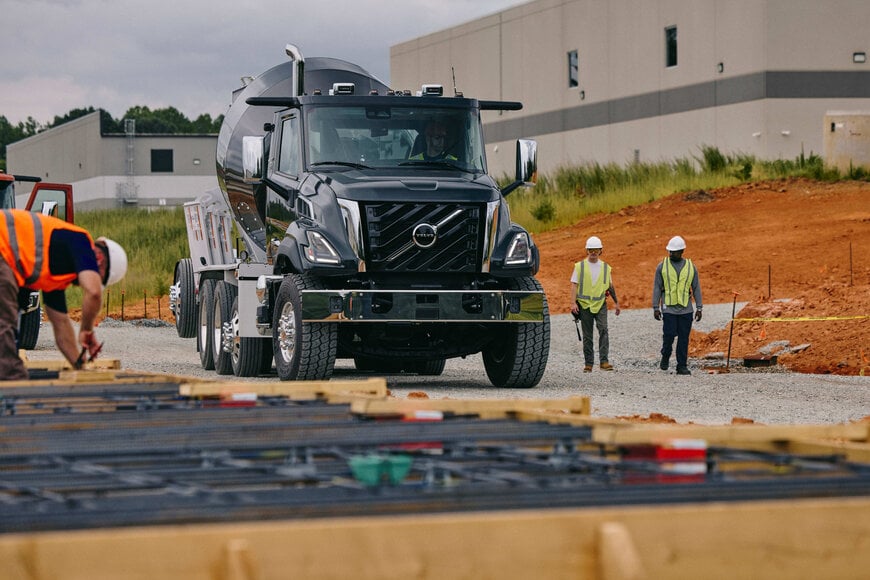
For the first time in North America, Volvo Trucks is introducing Remote Steer technology on its recently launched all-new Volvo VNX, a vocational and heavy-haul truck designed for demanding jobs such as construction. Available as a dealer-enabled option, the technology allows drivers to step outside the cab and manoeuvre the truck remotely at speeds of up to 5 mph using a handheld wireless controller. According to John Moore, product marketing manager at Volvo Trucks North America, anyone who has driven a remote-control car will understand the basic idea, but because this is a full-size work truck, Remote Steer has been built with the safeguards a jobsite demands, giving drivers more control in situations where every inch matters.
Better visibility on the jobsite
Positioning a concrete mixer for a pour or manoeuvring a dump truck on a crowded construction site often requires a spotter to guide the driver around workers, equipment and obstacles. Remote Steer lets drivers step outside the cab and see their surroundings first-hand, without repeatedly climbing in and out to check clearances. The improved visibility can help reduce the risk of collisions, streamline operations and free up supporting crew members for other tasks. As Moore points out, on a busy construction site what a driver can see makes all the difference, and Remote Steer provides a better view while the driver maintains full control of the truck, helping protect the people working around it and making it easier to manoeuvre in tight spaces.
Built-in safeguards
Remote Steer incorporates multiple safeguards designed for demanding jobsite conditions, and the driver stays in control at every step. The system is first switched on from inside the cab, after which the driver turns on the remote controller and links it to the truck. Each controller is programmed to work with only one vehicle identification number (VIN), and the truck stays in park until the driver releases the park brake on the controller and then pushes a toggle to go forward or reverse. Both the truck and the controller have emergency stop buttons, and the controller only works within a limited distance of the truck.
Integration with Volvo Dynamic Steering
Remote Steer builds on Volvo Dynamic Steering, which uses an electronically controlled motor to reduce steering effort and improve handling on rough terrain; the same technology makes it possible to control the truck's steering remotely. Because Remote Steer connects to the existing electrical system of the all-new Volvo VNX, it can easily be added at the dealership after delivery. To enable the function, trucks must be equipped with Volvo Dynamic Steering, I-Shift transmission, an electronic braking system and a Body Builder Module, together with the Remote Steer software. The all-new Volvo VNX, Volvo Trucks' next-generation vocational and heavy-haul truck for North America's toughest jobsites in construction, infrastructure and heavy haul, was revealed on 14 October 2026, with sales beginning on 26 October 2026.
Additional Context:
This section explains general principles of electronically assisted steering and remote vehicle control not included in the original press release.
In many heavy trucks, steering is provided by a hydraulic power-steering gear. Electronically assisted systems add an electric motor that works together with the steering gear, so the steering force can be adjusted by software, for example to reduce effort at low speed or to compensate for disturbances from uneven ground. Because the steering can then be actuated electronically, such systems can also support functions in which the steering input comes from a source other than the steering wheel.
Remote control of heavy vehicles is typically limited to low-speed manoeuvring and relies on several layers of protection, such as pairing each controller with a specific vehicle, limiting the operating range, requiring deliberate actions to release the brakes and select a direction, and providing emergency stop functions that bring the vehicle to a halt immediately.
Edited by an industrial journalist, Lekshman Ramdas, with AI assistance.
www.volvotrucks.us
