
constructionequipmentmag.com
16
'26
Written on Modified on
Hydraulic System & Control Updates for Compact Wheel Loaders
Bobcat Company upgrades its L65 and L95 compact wheel loaders with higher hydraulic pressure, integrated joystick controls, and expanded attachment compatibility.
www.bobcat.com
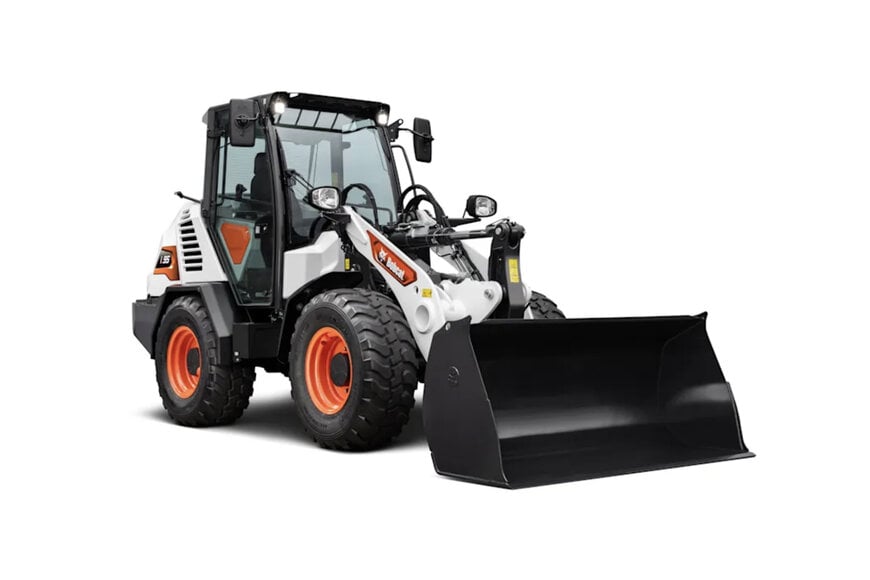
Material-handling workflows in construction, landscaping, and agriculture frequently require operators to alternate between bulk loading and hydraulically powered implements, creating productivity bottlenecks when hydraulic pressure or control ergonomics limit tool versatility. To address these multi-tasking demands on compact jobsites, Bobcat Company introduced hardware and control upgrades for its L65 and L95 compact wheel loaders, with North American availability through participating dealerships beginning in mid-October. The revisions center on a 15 percent increase in hydraulic system pressure, an integrated multifunction cab interface, and expanded compatibility for grading, forestry, and ground-engaging attachments.
Hydraulic Pressure Increase and Attachment Integration
High-demand attachments such as planers, stump grinders, and heavy-duty grading blades require sustained hydraulic force and precise speed modulation to maintain cycle efficiency without stalling. Bobcat increased maximum hydraulic pressure on the L65 and L95 by 15 percent to 3,408 psi, directly elevating bucket breakout force and hydraulic torque output for powered implements.
To support rapid tool changes across diverse jobsite tasks, both loaders incorporate a standard seven-pin electrical attachment control interface that automatically identifies compatible Bobcat implements upon connection. Paired with advanced attachment control logic, this system decouples engine speed and hydraulic auxiliary flow from ground travel speed. Operators can maintain optimal hydraulic power to a wood chipper, flail cutter, soil conditioner, or planer while independently modulating hydrostatic drive speed for fine grading and surface preparation. Newly supported attachments also include the box blade, box blade HD, dozer blade, and stump grinder.
Operator Interface and Drive-Response Architecture
Frequent switching between travel, lift-arm actuation, and auxiliary attachment functions often induces operator fatigue and slows cycle times in conventional cab layouts. The updated standard enclosed cab consolidates auxiliary hydraulic functions directly onto a new multifunction joystick, allowing simultaneous control of loader kinematics and attachment actuation without hand repositioning. Additional hardware updates include a standard rearview camera, keyless ignition, a revised keypad and jog shuttle layout, a consolidated lights and wiper stalk, an automatic ride-control activation switch to dampen bucket oscillation during transport, and a factory-installed radio on the L95.
At the control-strategy level, operators can configure customizable drive-response and workgroup-response modes. Adjusting drive response alters hydrostatic transmission acceleration and deceleration curves to match ground traction or tight-quarters maneuvering, while workgroup-response tuning modifies lift and tilt hydraulic sensitivity for delicate load placement or aggressive digging.
Structural Kinematics and Model Specifications
Compact wheel loaders are engineered to minimize ground disturbance and tire scrubbing compared to skid-steer loaders while maintaining tight turning radii in congested work zones. Both the L65 and L95 utilize an articulated steering joint providing a 40-degree articulation angle to navigate around stockpiles, buildings, and site obstacles.
While sharing the upgraded cab and hydraulic architecture, the two models target distinct payload and transport speed requirements. The L65 features a 0.85-cubic-yard standard bucket, a straight rated operating capacity of 3,160 lbs., and a maximum travel speed of 16.8 mph. Designed for higher-volume throughput and longer site-to-site transit, the L95 equips a 1.08-cubic-yard bucket, a straight rated operating capacity of 3,981 lbs., and a top travel speed of 24.9 mph.
Additional Context:
This section details technical specifications and competitive benchmarking not included in the original product announcement
Within the compact wheel loader segment, machines rated between 3,000 and 4,000 lbs. straight rated operating capacity represent a core utility class competing directly with compact track loaders for landscaping, municipal maintenance, and agricultural material handling. Unlike vertical-lift skid-steer architectures, articulated compact wheel loaders rely on a central pivot joint that allows front and rear wheels to track along identical paths, reducing surface tearing on finished turf and paved surfaces while providing higher roading speeds between dispersed jobsite zones. Comparable machines in this size and hydraulic class include the Caterpillar 906 and 908 compact wheel loaders, John Deere 244 P-Tier and 324 P-Tier, and Wacker Neuson WL34 and WL38. Industry-wide updates in this equipment tier increasingly focus on electro-hydraulic pilot controls, automated attachment recognition via multi-pin CAN-bus connectors, and decoupled creep-speed functionality to support high-flow hydraulic attachments traditionally reserved for skid-steer carriers.
Edited by Natania Lyngdoh, Induportals editor, with AI assistance.
www.bobcat.com
