
constructionequipmentmag.com
16
'26
Written on Modified on
Sandvik Rotary Geo Software Interprets Blasthole Data to Improve Mining
By calculating specific energy without extra hardware, this onboard algorithm identifies rock hardness variations immediately, helping mining teams optimize blast designs and explosive loading.
www.home.sandvik
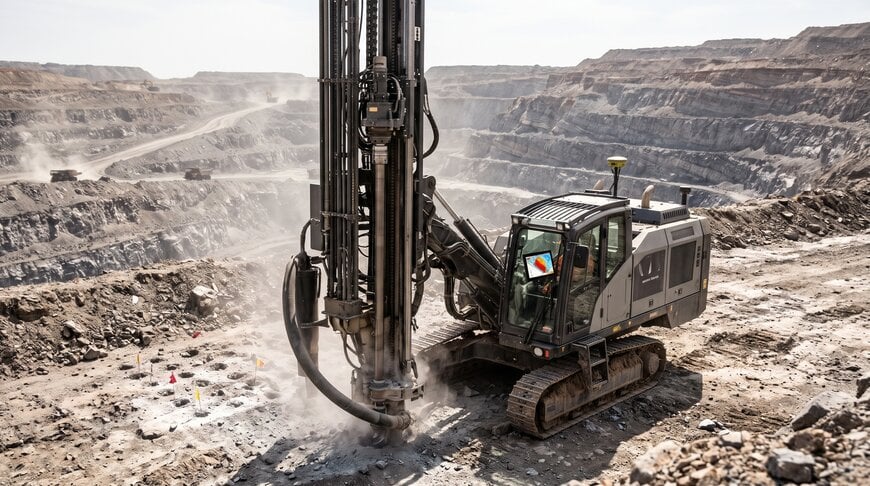
In surface mining and quarry operations, geological formations rarely exhibit uniform mechanical properties across a blast pattern. Variations in rock hardness and strata thickness directly influence penetration rates, drill bit wear, and blast fragmentation quality. Without localized subsurface data at the borehole level, blasting engineers often rely on generalized geological models or manual operator logs, which can lead to overcharging in soft zones or inadequate fragmentation in hard rock. Addressing this operational gap requires continuous, automated measurement while drilling — a core capability in modern mining automation and drill-and-blast optimization.
To provide actionable ground intelligence without adding physical sensors to the rig, Sandvik has introduced Rotary Geo. Designed for Sandvik i-series rotary blasthole drills equipped with TIM3D drill navigation systems, the software suite pairs an onboard analytical algorithm with the iLink Data Interface. By utilizing existing telemetry generated during standard drilling operations, the system characterizes subsurface formations in real time and delivers georeferenced rock hardness data directly to operators and blasting crews.
How Specific Energy Calculation Measures Rock Hardness
Rotary Geo operates on the geomechanical principle of specific energy, defined as the mechanical energy required to excavate a unit volume of rock. As a rotary drill advances through a borehole, the software continuously records operational drilling parameters — such as rotary torque, pulldown force, rotational speed, and penetration rate — and computes the specific energy expended at each depth interval. Because higher compressive strength and denser lithologies require greater energy to fracture, fluctuations in calculated specific energy serve as a direct quantitative indicator of relative rock hardness.
By linking these calculations to spatial coordinates via the TIM3D navigation system, Rotary Geo generates georeferenced profiles of the strata along the entire length of each borehole. Inside the cab, onboard visualization displays these real-time hardness transitions, enabling drill operators to recognize changing ground conditions immediately and adjust drilling parameters accordingly.
Workflow Integration and Rapid Data Transfer
In challenging geological environments, the window between completing a borehole and loading explosives can be strictly constrained. Rotary Geo was developed in collaboration with a surface mining operation facing significant groundwater ingress, where boreholes had to be loaded with explosives rapidly after drilling to prevent hole collapse or water-induced charge degradation. Under such time-critical conditions, waiting for centralized laboratory analysis or manual geological logging is impractical.
To support immediate field decisions, the package includes the iLink Data Interface, which allows site personnel to access and download hole-by-hole rock hardness logs as soon as drilling finishes. Blasting crews can use these localized profiles to adjust explosive loading densities and stemming depths on the bench, matching energy distribution to actual rock resistance. For broader engineering analysis across complete blast patterns, the software integrates with the My Sandvik Onsite platform, storing datasets in a central database where mining engineers and geologists can incorporate the findings into long-term mine planning and blast design models.
Field Verification in Variable Strata
During development testing at the partner mine site, the site geology team validated the algorithm's rock hardness interpretations against actual ground conditions. The georeferenced data revealed substantial discrepancies between prior geological assumptions and physical reality: one zone previously modeled as uniformly hard rock was identified as containing softer strata, while another section expected to hold mixed formations was found to consist of harder rock. Identifying these variations before blasting enables teams to refine fragmentation control, reduce unnecessary explosive consumption in weaker zones, and avoid oversized boulder generation in harder formations.
Additional Context
This section details technical specifications and competitive benchmarking not included in the original product announcement.
In the mining industry, evaluating rock mass characteristics using real-time drill telemetry is commonly categorized as Measurement While Drilling (MWD). Originally adapted from oil and gas exploration, MWD systems on surface blasthole drills rely on mechanical specific energy (MSE) equations — a concept formalized in rock mechanics research by Teale in 1965 — to correlate rig power consumption with rock compressive strength.
Unlike aftermarket MWD retrofits that require installing external pressure transducers, strain gauges, or auxiliary data loggers onto older hydraulic rigs, OEM-integrated software solutions like Rotary Geo leverage native CAN-bus sensor streams already present on modern automated drill rigs. Comparable MWD analytics platforms exist across major surface mining equipment manufacturers, such as Epiroc's Measure While Drilling system and Caterpillar's Terrain for drilling, both of which similarly translate rotary torque, feed force, and penetration rates into strata hardness logs for downstream blast optimization. By integrating directly with the TIM3D navigation architecture and the My Sandvik Onsite ecosystem, Rotary Geo aligns with broader industry adoption of closed-loop digital drill-and-blast workflows, where high-resolution borehole telemetry replaces sparse exploration core sampling to guide automated explosive charging trucks.
Edited by Evgeny Churilov, Induportals Media - Adapted by AI.
www.mining.sandvik
