
constructionequipmentmag.com
23
'26
Written on Modified on
How to choose the right powertrain for underground mining trucks
Selecting the right powertrain requires balancing operational requirements, energy efficiency, emissions, and performance in underground mining conditions.
www.epiroc.com
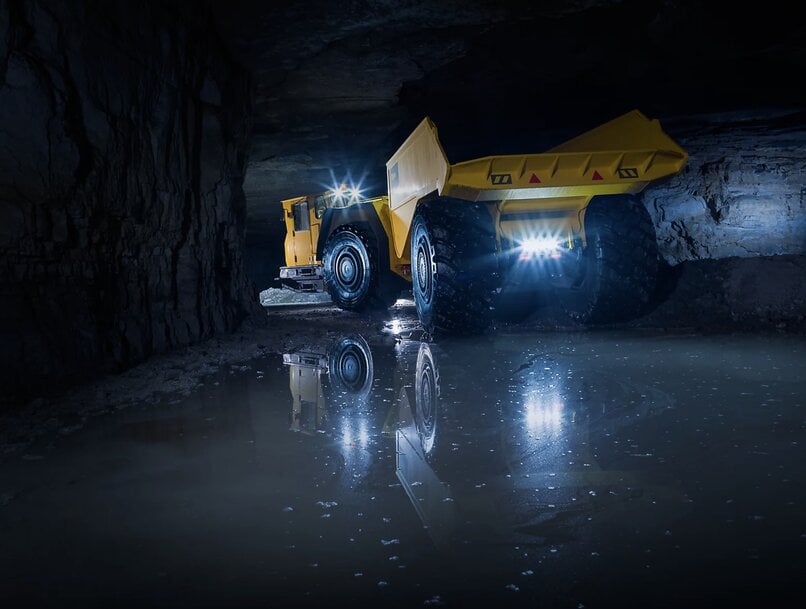
Selecting a powertrain for an underground mining truck depends on the application, operating conditions, mine life, total cost of ownership (TCO) and sustainability targets. No single solution suits every mine.
Diesel-powered trucks remain a practical choice for short planning horizons because of their lower upfront costs, proven technology and relatively simple infrastructure requirements. Diesel-electric trucks typically offer lower fuel consumption, reduced maintenance and better performance than diesel-mechanical models.
For longer mine lives, battery-electric and trolley-assisted trucks become more attractive. Battery-electric trucks eliminate tailpipe emissions and reduce heat generation, potentially lowering ventilation costs. However, they require charging or battery-swapping infrastructure and careful operational planning. Trolley-assisted trucks can offer the lowest TCO on high-production haul ramps over long mine lives, despite substantial initial infrastructure costs.
Diesel-battery hybrids can reduce fuel consumption and emissions, depending on the duty cycle and battery size. Fuel cells are not currently a suitable solution for underground mining because of technical, economic and safety challenges.
Powertrain types
1. Diesel-mechanical
A conventional mining truck powertrain comprising a diesel engine, mechanical transmission and gearbox.
Advantages
- Proven technology and familiar maintenance procedures.
- Low capital expenditure (CAPEX).
- Long operating time per tank and fast refueling.
- Relatively simple infrastructure.
Drawbacks
- Exhaust emissions and heat increase ventilation requirements and operating costs.
- High diesel costs and CO₂ emissions.
- Significant maintenance requirements and limited component lifetimes.
- Alternative fuels such as HVO100 can reduce global CO₂ emissions but cost more.
2. Diesel-electric
A diesel engine drives a generator that supplies electricity to one or more traction motors. This configuration is not considered a hybrid system.
Advantages
A diesel engine drives a generator that supplies electricity to one or more traction motors. This configuration is not considered a hybrid system.
Advantages
- Lower fuel consumption and transmission losses.
- Fewer moving parts and reduced maintenance.
- Lower exhaust emissions, CO₂ emissions and heat output.
- Potentially better performance and lower TCO despite higher truck costs.
Drawbacks
- Higher drivetrain costs.
- Some maintenance tasks require electrical expertise.
3. Battery-electric
Battery-electric trucks use onboard batteries to power electric motors. Batteries can be charged onboard or removed for off-board charging.
Advantages
Battery-electric trucks use onboard batteries to power electric motors. Batteries can be charged onboard or removed for off-board charging.
Advantages
- Zero tailpipe emissions and lower heat output, improving working conditions and potentially reducing ventilation requirements.
- Potentially lower CO₂ emissions, depending on the electricity source.
- Higher installed power can improve speeds on grade and productivity.
Drawbacks
- Higher purchase costs, although battery-as-a-service models can reduce CAPEX while increasing operating expenditure (OPEX).
- Battery weight and volume can reduce payload capacity or operating time.
- Charging downtime can affect productivity.
- Battery swapping avoids charging downtime but requires additional batteries, space and equipment.
- Charging infrastructure costs more than diesel refueling infrastructure. Mines must balance charger installation costs against the productivity impact of longer trips to charging stations.
- Higher charging power reduces charging time but increases charger and infrastructure costs.
4. Hybrid (diesel-battery)
A diesel-battery hybrid typically combines a battery with a diesel-electric drivetrain. The battery stores regenerative braking energy and supports the diesel engine during acceleration and uphill operation.
Long declines can provide substantial energy recovery, but storing this energy requires large batteries that may weigh several tonnes and reduce payload capacity. Smaller batteries preserve payload but recover less energy. The optimal configuration therefore depends on the duty cycle.
5. Plug-in hybrid
Plug-in hybrids can charge their batteries from an external power source. However, mining trucks typically operate continuously throughout a shift, leaving limited opportunities for charging and reducing the benefits of this configuration.
6. Trolley-assisted (battery-trolley)
Trolley trucks draw electricity from overhead catenary wires or a conductor rail through a current collector. Their batteries can charge during operation, and the trucks run on battery power when disconnected from the trolley system.
Advantages
- Zero tailpipe emissions during operation.
- Smaller batteries can reduce lifetime battery costs.
- Higher ramp speeds can shorten cycle times.
- Reduced charging or refueling downtime enables near-continuous operation when combined with autonomous systems.
Drawbacks
- Significant electrical infrastructure is required, including wires, rails and substations.
- Dependence on trolley lines reduces operational flexibility.
- Extending trolley infrastructure as ramps grow can be time-consuming.
- Modern battery-trolley trucks offer advantages over diesel-trolley systems, which produce exhaust emissions and are significantly slower when disconnected from trolley lines.
7. Fuel cells
Fuel cells generate electricity from hydrogen and oxygen, producing water and heat. Fuel-cell vehicles also use a smaller battery to manage power peaks.
Although they offer zero tailpipe emissions and potentially longer operating times than battery-electric trucks, several challenges remain:
Fuel cells generate electricity from hydrogen and oxygen, producing water and heat. Fuel-cell vehicles also use a smaller battery to manage power peaks.
Although they offer zero tailpipe emissions and potentially longer operating times than battery-electric trucks, several challenges remain:
- Immature technology and insufficient component lifetimes for underground mining environments.
- High equipment and hydrogen fuel costs, resulting in high CAPEX, OPEX and TCO.
- Limited hydrogen infrastructure.
- Safety concerns associated with high-pressure hydrogen storage, leaks, fires and explosions in confined spaces.
Fuel cells are therefore not currently considered suitable for underground mining vehicles.
Which powertrain should you select?
Short planning horizon
For mines with a short remaining life or contractors operating under short-term agreements, diesel-powered trucks are generally the natural choice when a fast return on investment is required. Diesel-electric models are often more efficient than diesel-mechanical alternatives, although the best option depends on TCO.
The ventilation system must be capable of handling engine exhaust and heat.
Long planning horizon
When the planning horizon matches or exceeds the expected truck lifetime, alternative power sources warrant consideration.
Diesel-electric trucks can offset their higher purchase costs through improved productivity and lower fuel consumption. Battery-electric trucks require charging infrastructure and may have higher CAPEX or OPEX, depending on the battery financing model. However, savings from reduced ventilation, cooling and improved air quality can justify the additional costs. Environmental targets and CO₂ taxes may further strengthen the business case.
For long-life operations with high production volumes on the same ramp, trolley trucks often offer the lowest TCO. Their initial investment is high, but operating costs can be substantially lower than those of diesel or battery-only alternatives.
Ventilation requirements
Ventilation is a major cost and operational challenge in underground mining. Diesel emissions drive ventilation demand, while high ambient temperatures can also necessitate energy-intensive cooling.
Reduced ventilation requirements can lower costs associated with fans, shafts, ventilation ducts, energy consumption and cooling. These savings can sometimes exceed the additional investment in battery-electric or trolley-powered trucks.
However, electrification does not always deliver substantial ventilation savings. If blast gases are the dominant ventilation requirement, savings may be limited to reduced power consumption. The greatest opportunities arise in greenfield projects, where ventilation can be designed around electric equipment, and mine expansions where existing ventilation infrastructure is nearing capacity.
Diesel-electric trucks and diesel-battery hybrids can slightly reduce ventilation requirements compared with diesel-mechanical trucks, but the reduction is generally limited.
High sustainability ambitions
Strong sustainability targets can accelerate the adoption of electric trucks and other electric equipment. The challenge is balancing CO₂ reduction goals with economic realities.
Diesel-electric trucks and diesel-battery hybrids can serve as transitional solutions, contributing to nearer-term targets such as those for 2030, although they may not meet longer-term 2040 or 2050 targets on their own.
Ultimately, powertrain selection requires balancing mine life, duty cycle, productivity, ventilation requirements, energy prices, infrastructure investment and sustainability targets. The best solution is the one that meets the specific operational and economic requirements of the mine.
Edited by Romila DSilva, Induportals Editor, with AI assistance.
