
Lower Thames Crossing becomes world’s first project to deploy Volvo A40 Electric
Four battery-powered articulated haulers supplied to BMJV support foundation works for the UK road and tunnel scheme using green-hydrogen-generated electricity.
www.volvoce.com
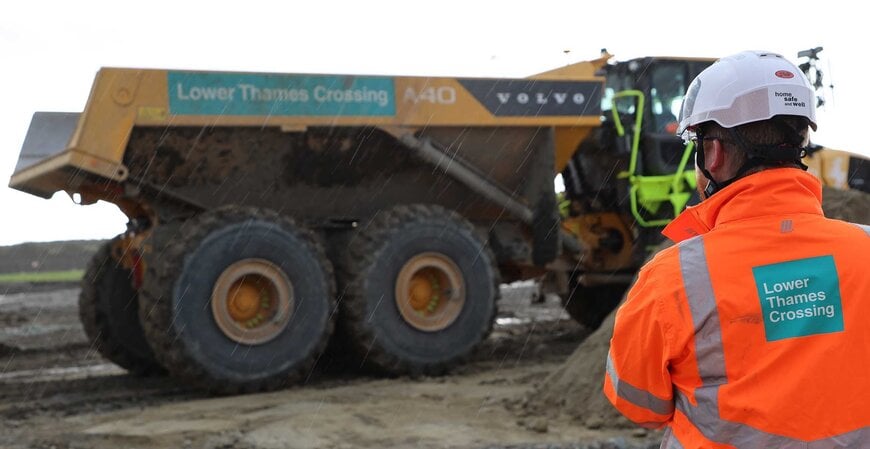
Volvo Construction Equipment (Volvo CE) has delivered the world's first Volvo A40 Electric articulated haulers to BMJV for deployment on the Lower Thames Crossing, one of the United Kingdom's largest infrastructure developments. Arriving on the Essex worksite from Volvo CE's manufacturing facility in Braås, Sweden, and supplied and supported by UK dealer SMT GB, the four machines demonstrate zero-exhaust-emission earthmoving at scale on a programme committed to carbon-neutral construction.
Setting a benchmark for zero-emission civil engineering
Arriving 60 years after Volvo CE built Gravel Charlie, the world's first articulated hauler, the A40 Electric is the world's first battery-powered articulated hauler in its class. BMJV—a joint venture between Bouygues Travaux Publics and J Murphy & Sons—is operating the four units to construct the foundations and structures for the road and entrance to the new tunnel under the Thames.
Shaun Pidcock, Lower Thames Crossing Programme Director, noted that transitioning to electric machinery no longer involves operational compromise, showing that heavy earthmoving tasks can be executed cleanly while improving conditions for site personnel and neighbouring communities.
Spanning approximately 14.3 miles—including 2.6 miles of tunnels under the Thames—the Lower Thames Crossing will connect Kent and Essex and nearly double road capacity across the river east of London. Part of the biggest investment in the UK road network for a generation, it is set to be the first major infrastructure programme in Britain with carbon-neutral construction: diesel has not been used on its worksites since 2025, and the tunnel and roads are being built only with hydrotreated vegetable oil (HVO), electric and hydrogen-powered machines. More than 2,500 people now work on the project, with the new road expected to open in the early to mid-2030s.
Darren Fitch, Head of Electromobility Sales Europe at Volvo CE, stated that operating the A40 Electric haulers on such a demanding civil engineering project proves electrification can satisfy heavy construction requirements while delivering zero exhaust emissions, lower ambient noise, safer jobsites, and reduced total cost of ownership.
Green-hydrogen charging and technical specifications
On the Essex site, the haulers are recharged using electricity generated by power units fuelled with British-manufactured green hydrogen. Gautier Tortajada, Plant Manager and Electrical Lead at BMJV, explained that site teams rapidly integrated the vehicles into daily workflows by establishing charging routines during breaks and in the evening to suit shift patterns.
Each Volvo A40 Electric combines a 39-tonne payload capacity with a 540 kWh lithium-ion battery pack, delivering roughly six hours of runtime per charge depending on duty cycle. Using a 350 kW fast charger, the battery recharges from 10% to 90% in approximately one hour, while regenerative braking feeds energy back to the battery. Operators use the same controls as on Volvo CE's diesel haulers, with lower noise and no exhaust emissions.
Additional Context:
This section explains general principles of heavy-duty electric drivetrain architecture and off-grid hydrogen microgrid charging in civil construction not included in the original press release.
In large-scale earthmoving operations, articulated haulers experience extreme cyclical load profiles: high tractive torque is required to climb steep, soft-ground gradients under full 39-tonne payloads, followed by sustained braking during loaded descents. Electric drivetrains replace mechanical torque converters and multi-gear powershift transmissions with electric traction motors capable of delivering peak torque from zero rpm, while regenerative braking converts gravitational potential energy back into electrical charge during downhill runs—reducing mechanical wet-disc brake wear and extending battery range.
Because major linear infrastructure corridors such as tunnel portals often sit kilometres away from high-capacity utility grid substations, deploying 350 kW DC fast chargers on remote earthworks sites requires temporary off-grid power generation. Pairing green-hydrogen fuel cells or hydrogen combustion generators with stationary buffer batteries enables high-rate DC fast charging without local carbon emissions or high-voltage grid reinforcement delays.
Edited by an industrial journalist, Lekshman Ramdas, with AI assistance.
